Turkish Video Calls with Grandparents: A Simple Plan for Children Abroad
Replace “Say something in Turkish” with a kite, a drawing and a question the child actually wants to ask.
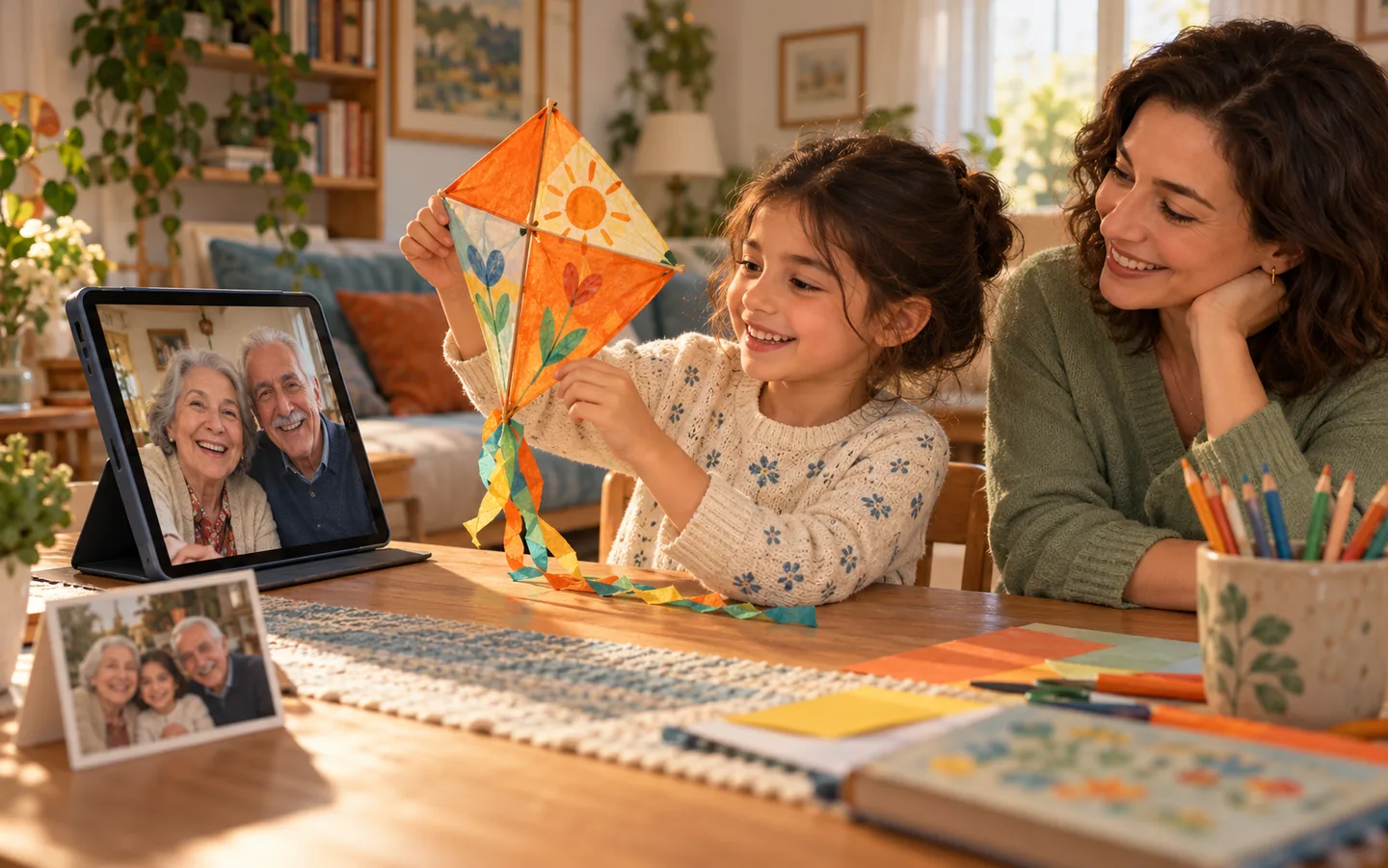
Quick answer: Prepare one thing your child can share and one question they would like to ask in Turkish. A drawing, a small everyday event or a grandparent's memory can give the call a clear topic. The purpose is family connection, not testing the child's Turkish. The five-minute outline below is a flexible suggestion, not a duration target that must be completed.
2026-10-27 · Stayeng parent guide
Key points
- Choose a visible topic instead of only broad questions.
- Let the grandparent share something as well.
- Do not end the exchange because an answer includes another language.
- Prefer a comfortable short conversation to a long interrogation.
Put this guide into practice
- We chose an object or drawing before the call.
- We prepared a question my child wanted to ask.
- We asked the grandparent to use short turns and leave response time.
- We noted something to share on the next call.
How could you keep the conversation open?
Choose an approach that protects the family connection and makes room for Turkish.
The child shows a kite but says only the English word “kite”. What could the adult say?
- “I will not look until you say it in Turkish.”
- “Uçurtman çok renkli. Bunu sen mi yaptın?”
- Turn the exchange into a grammar test
Answer and explanation
“Uçurtman çok renkli. Bunu sen mi yaptın?”: The adult supplies the Turkish word within a meaningful response: “Your kite is very colourful. Did you make it?” The child's contribution remains the focus.
“What did you do today?” gets no answer. Which is a more concrete starting point?
- “Can you show me the drawing on your table?”
- Repeat the same question louder several times
- “Why do you never talk?”
Answer and explanation
“Can you show me the drawing on your table?”: A visible object allows the child to point, show or answer briefly. Silence should not immediately be treated as unwillingness.
The call is going well, but the child becomes tired. What could you do?
- Insist on finishing the planned duration
- Immediately ask more difficult questions
- Finish with a short goodbye and choose something to share next time
Answer and explanation
Finish with a short goodbye and choose something to share next time: Completing a plan is less important than the relationship. Choosing the next drawing or story can leave a natural topic for another call.
Why might a child who knows Turkish go quiet on a call?
A quick succession of “How was school?”, “What did you learn?” and “What did you do today?” can leave a child unsure where to start. Video delay, tiredness or difficulty finding a topic can also get in the way. One quiet call is not enough evidence to judge a child's Turkish.
Make the subject visible. A kite, drawing or recently finished project gives the grandparent something specific to notice. Asking about a favourite part may be easier to answer than requesting a full summary of the day.
Before the call: one topic and one question
Choose one object together. Recall two or three useful Turkish words, such as uçurtma (kite), ip (string) and turuncu (orange). A full speech is unnecessary. Do not turn an adult-selected topic into a performance assignment.
Give the grandparent a small role too: show a photograph or object and say a couple of sentences about it. The child should not be the only person answering questions. A reciprocal exchange creates a reason to listen as well as speak.
A flexible five-minute conversation outline
Begin with a greeting and a brief check-in. Let the child show the chosen item. The grandparent responds to one detail, then shares something of their own. End by choosing a small topic for next time and saying goodbye.
There is no need to time every stage or complete every step. A child may contribute one sentence and spend more time listening. If they want to say more, the outline should not force the conversation to stop.
- Greet: “Merhaba dede, nasılsın?” — Hello Grandpa, how are you?
- Show: “Sana uçurtmamı göstermek istiyorum.” — I want to show you my kite.
- Describe: “İpi uzun.” — Its string is long.
- Ask: “Sen küçükken uçurtma uçurur muydun?” — Did you use to fly kites when you were little?
- Finish: “Bir dahaki sefere resmimi göstereceğim.” — Next time I will show you my drawing.
Build on the message rather than correcting every word
If your child says “Turuncu”, you might respond “Evet, uçurtmanın turuncu kısmını sen boyamışsın” — yes, you painted the orange part of the kite. Leave time for a response before adding another question. Frequent pronunciation corrections can make sharing feel like a test.
The multilingual-learning resource linked by ASHA emphasises supportive language use and valuing practice over perfection. This call plan follows that broad approach; it is not a research finding that a particular number of minutes will produce language gains.
What if the reply comes in English or another language?
Respond to the meaning first. If the child says “I made it”, you can reply “Bunu sen yaptın! Hangi kısmı önce yaptın?” — you made it; which part did you make first? Supply a missing word if needed rather than translating the entire conversation on the child's behalf.
Do not make speaking Turkish a condition for family affection or acceptance. A parent can briefly bridge a difficult exchange, then return the conversation to the child and grandparent. If the grandparent speaks only Turkish, showing objects or pictures can help build shared meaning.
Match the topic to the child's interests
A younger child might show a toy and name its colour. A primary-school child could explain a drawing. An older child might ask about the story behind an old photograph or why a family recipe matters. These are starting ideas, not fixed developmental stages.
After the call, note a useful phrase and one question for next time instead of giving a score. You do not need to record a private family conversation without permission; a brief parent note can capture what helped.
How can Stayeng Turkish lessons support the goal?
Share the family-conversation goal with the teacher in Stayeng's Turkish lessons for children living abroad. You can ask for support with the words for a real event, forming a useful question or putting a short memory in order.
A lesson does not replace the family call. A phrase prepared with a teacher can be tried at home, and a difficult question from home can become a starting point for a later lesson. Choose one small target that connects practice to something the child genuinely wants to communicate.
Want to bring this practice into a one-to-one lesson?
Discuss your child’s speaking, reading and writing goals separately with the teacher. Explore Turkish lessons or choose a free trial to discuss a starting point together.
Frequently asked questions
Must the whole video call be in Turkish?
It does not need to be a rigid success condition. Build an understandable exchange around the family's language abilities, offer Turkish models and support the child's participation. Brief explanations or visual help may be useful.
My child understands but does not answer. Should I insist?
First offer a more concrete topic and a smaller role, such as showing an object or choosing between two options. Silence in one call is not sufficient evidence of a child's language level or willingness.
How long should calls last?
Five minutes is only a suggested starting point. A call may be shorter or longer depending on the child's and grandparent's interest, energy and the natural exchange.
Can Turkish lessons replace family conversations?
No. A lesson can support vocabulary and expression; a family call provides a personal relationship in which to use them. Choose small goals that allow the two experiences to complement each other.