Show and Tell in English: Help Your Child Present One Favourite Object
Choose an object, add two details and explain why it matters. Build a short presentation without reading a memorised script to the camera.
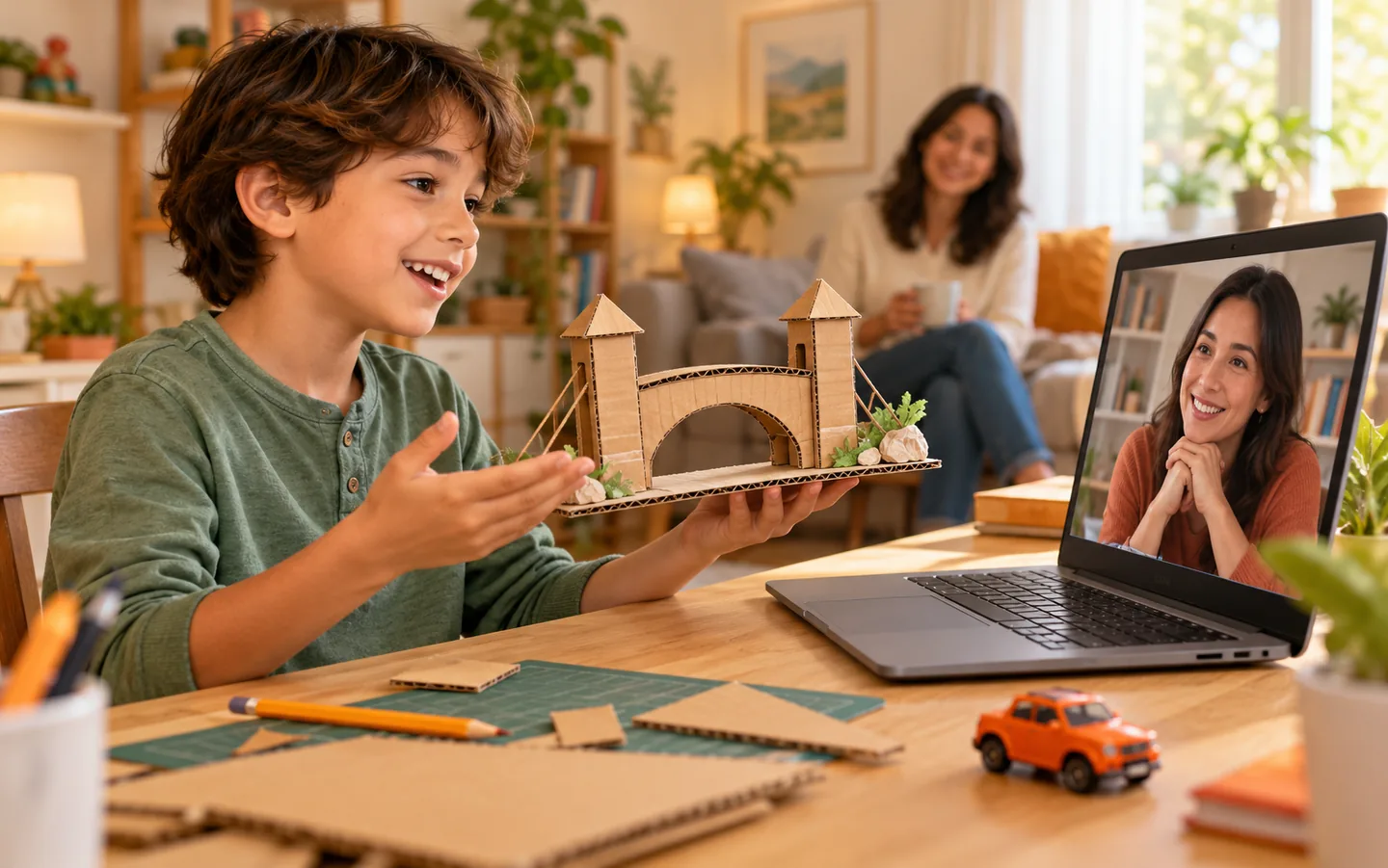
Quick answer: Show and tell means showing a chosen object and talking briefly about it. Start with four prompts: what is it, what is it like, why does it matter to you, and what would the listener like to ask? The object makes the topic concrete. The goal is understandable communication, not a perfectly memorised speech.
2026-10-27 · Stayeng parent guide
Key points
- Let the child choose the object; it need not be expensive or new.
- Prepare a few keywords rather than a complete script.
- Use a listener's question to turn presenting into conversation.
- Two meaningful sentences can be enough for a first attempt.
Put this guide into practice
- My child chose an object they wanted to explain.
- We checked that the object was visible on camera.
- We rehearsed using a few keywords.
- We answered one question from the listener.
Build a small presentation
A child wants to explain a handmade cardboard bridge. Choose the options that make the presentation clearer and easier.
Which sentence gives the listener a clear starting point?
- This is a bridge I made.
- Because yesterday blue.
- You already know everything.
Answer and explanation
This is a bridge I made.: It tells the listener what the object is. A detail or personal connection can follow.
Which preparation supports speaking in the child's own words?
- Memorising a long speech written by an adult
- A few prompts: bridge – cardboard – two towers – toy car
- Speaking immediately without looking at the object
Answer and explanation
A few prompts: bridge – cardboard – two towers – toy car: Keywords provide an order without deciding every sentence for the child. Adjust the amount of help to the learner.
Which follow-up question is directly connected to the object?
- What is the capital of every country?
- Why did you stop talking?
- Can a toy car go across your bridge?
Answer and explanation
Can a toy car go across your bridge?: A concrete, relevant question extends the exchange. The child can show the bridge or test it with a toy car while answering.
How does an object help a child speak?
“Tell me something in English” is a very broad invitation. A homemade bridge, a favourite stone or a drawing gives the conversation a visible subject. The listener can focus on an interesting detail rather than only on grammar.
British Council TeachingEnglish includes showing real objects to the camera among possible show-and-tell activities for online children's classes. The four-part outline below is Stayeng's own short home rehearsal built around that practical idea.
1. Choose an object and two details
Offer three possibilities: something handmade, an everyday item or the child's own drawing. Let the child choose. Select an object that is comfortable to share rather than an identity document, an address label or a photograph containing someone else's private information.
Put it on the table and identify two details: colour, material, number of parts, how it was made or what it does. A beginner might use “It is blue” and “It has two towers”. The content does not need to be impressive to be worth explaining.
2. Build a short explanation with four prompts
For a cardboard bridge, begin with “This is my bridge.” Add “It is made of cardboard. It has two towers.” A personal connection might be “I use it with my toy cars.” The listener now hears the name, some features and a reason the child chose it.
Do not require this exact model. Adapt it to the object and language your child knows. If made of is not appropriate yet, a teacher can help with “It is a cardboard bridge”, or the child can begin with “My bridge. Two towers.”
- Introduce: “This is…”
- Describe: “It is…” / “It has…”
- Connect personally: “I use it…” / “I like it because…”
- Invite a response: “Do you have a question?”
3. Try the camera and a cue card
Check whether the object fits in the camera frame. Bring a small detail closer briefly, then return it so the child's face can be seen. Rest the object on a table rather than asking a child to hold it up throughout a long explanation.
Put a few keywords or drawings on the cue card instead of full sentences. An adult can model a short version before the child tries. Avoid making the activity a race. If two sentences feel comfortable, add one detail; more speaking time is not automatically a better presentation.
4. Turn the presentation into a conversation
Instead of only saying “Good job”, the listener asks something about the object: “Can a toy car go across it?” or “Which part was difficult?” If the child does not understand, they can ask for repetition or pause before replying.
Agreeing on the first question beforehand can be helpful at the beginning. In a later round, add a relevant question the child has not memorised. The goal is a small exchange beyond the prepared explanation, not an unexpected interrogation.
How can this fit a Stayeng lesson?
Before a live one-to-one English lesson, tell the teacher your child would like to show an object. The teacher can choose an appropriate focus: introducing, describing or answering a question. Advance notice makes it easier to fit the activity into the lesson.
Afterwards, look for three things: could the listener identify the object, did the child offer a detail independently, and could they respond to a connected question? Try again with another object to observe whether less support is needed.
Want to bring this practice into a one-to-one lesson?
Choose an activity from this guide to discuss with your teacher. For regular lessons, compare package lesson counts, lesson lengths and total prices. If you would like to meet a teacher first, choose a free trial.
Frequently asked questions
How long should a child's show-and-tell last?
There is no compulsory length. Two short sentences and a response to one question may be enough to start. Add a detail or personal reason when the child is comfortable.
Do we need to buy a toy?
No. A drawing, cardboard model, everyday object or safe item collected outdoors can work. What matters is that the child has something they want to say about it.
Is reading from a script wrong?
Reading can provide initial support. For a speaking goal, gradually reduce a full script to a few prompts. Reading fluently and answering an unprepared question are different skills.
Can a four-year-old try this?
With suitable support, a young child can show an object and name it or say its colour. Do not expect a long presentation. Adapt the language and duration to the child's interests and existing knowledge.