English Reading Comprehension for Kids: Be a Story Detective
Reading the words aloud and understanding the story are different tasks. Look for clues together instead of measuring reading speed.
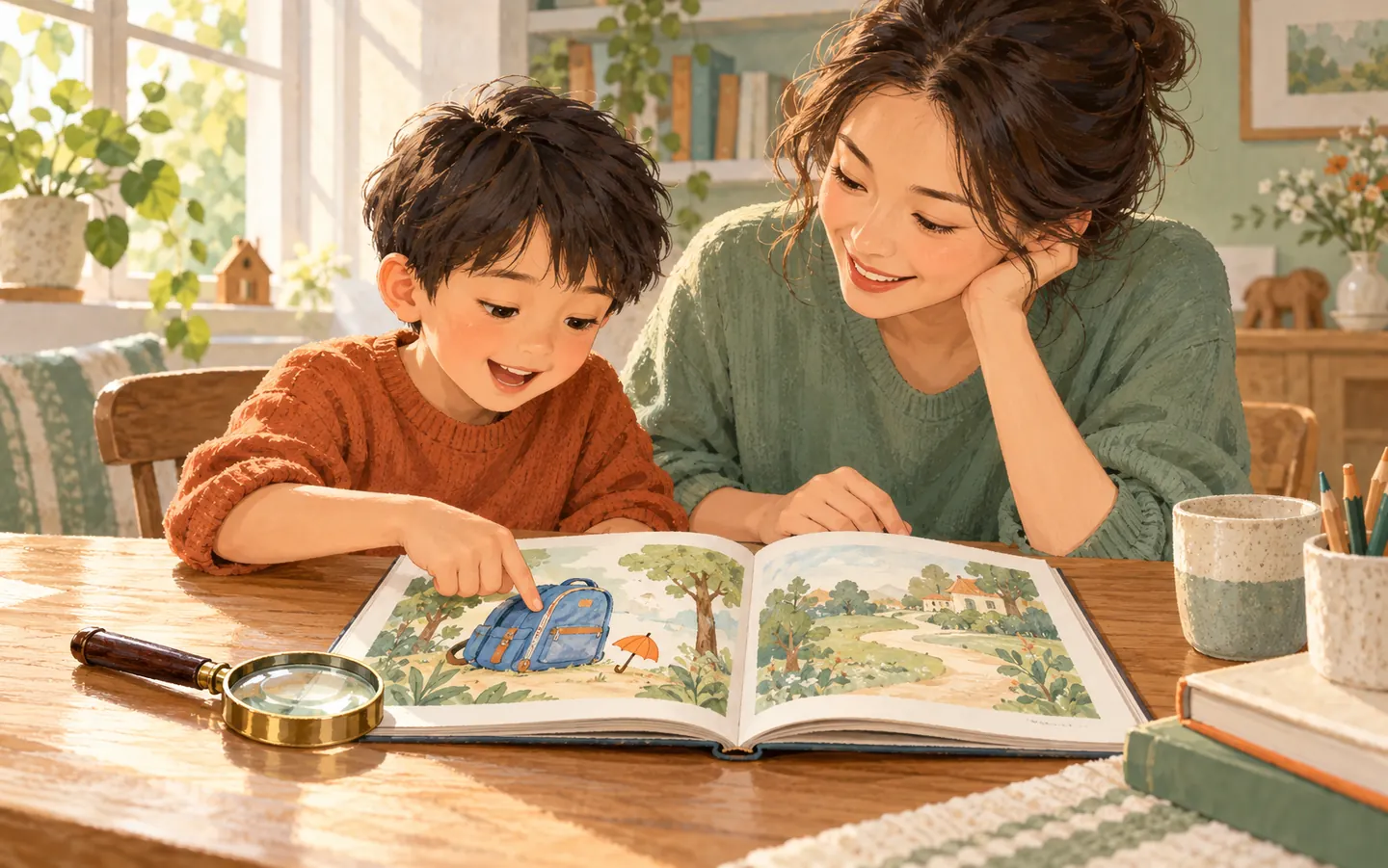
Quick answer: Choose a short English text, talk about the main event and find the sentence that supports an answer. Smooth reading aloud does not automatically show that the story makes sense to the child. If decoding is difficult, read the text aloud yourself and observe listening comprehension separately. Our original story below helps separate finding facts from making an inference.
2026-10-23 · Stayeng parent guide
Key points
- On the first reading, find the main event rather than stopping at every word.
- Point to the clue that supports an answer.
- You do not have to invent information the text does not provide.
- Treat decoding, vocabulary and comprehension as different things to observe.
Put this guide into practice
- We read or listened to the short story together.
- We described the main event in one sentence.
- We found the evidence for one answer in the text.
- We chose another text of similar length for the next attempt.
Mini story: The Blue Bag
Mina walks to the park with a blue bag. There is a sandwich and a small umbrella in her bag. At the park, she meets her friend Leo. Dark clouds cover the sky. Mina opens her umbrella. Leo stands beside her. They stay dry and walk home together. — Read the story, or ask an adult to read it aloud, then choose your answers.
What is in Mina’s bag?
- A ball and a book
- A sandwich and a small umbrella
- Two hats
Answer and explanation
A sandwich and a small umbrella: The second sentence tells us directly. This question asks you to locate information that is stated in the text.
Why might Mina open her umbrella?
- She may expect rain because of the dark clouds
- The story says it is very hot
- Leo is selling her an umbrella
Answer and explanation
She may expect rain because of the dark clouds: The dark clouds and staying dry suggest rain. We say “might” because the text does not directly explain her reason.
What colour is Mina’s umbrella?
- Definitely blue
- Definitely red
- The text does not say
Answer and explanation
The text does not say: The bag is blue. The text does not give the umbrella’s colour. A colour in the cover illustration is not evidence from this text.
Reading the words and following the meaning
A child may pronounce each word but lose track of what the character does. The reverse is possible too: they follow the events when an adult reads but spend considerable effort decoding words alone. One home activity cannot establish the reason.
To explore the difference, try two tasks with the same short text. Read together and ask who is in the story. Then read a part aloud yourself and ask what happened. Note which support made meaning clearer; you do not need to assign a level label.
Choose a text with one manageable event
Start with a short text containing one event, a few characters and familiar vocabulary. If too many words are unknown, every line can become dictionary work. Choosing an easier text is a practical adjustment, not a failure.
The British Council’s guide to stories recommends using illustrations before reading and brief comprehension checks afterwards. Pictures can support understanding, but distinguish an answer found in a picture from one found in the words.
Separate three types of question
The mini story’s questions do different jobs. The first locates stated information. The second connects clues. The third recognises that a detail has not been supplied. All three can be part of a useful reading conversation.
- Find a fact: “What is in the bag?” Point to the sentence that tells you.
- Make an inference: “Why might Mina open the umbrella?” Explain the clue behind the possible answer.
- Recognise a limit: “What colour is the umbrella?” If the text does not say, “We don’t know” is enough.
Use “How do you know?” as an invitation to find a clue together, not a challenge to defend a score.
A short reading routine for home
Look at the title and invite a prediction. Read once to find the main event. Choose one factual question, listen to the answer and return to the relevant sentence. Finally, ask your child to summarise the events with two simple drawings.
You do not need every question in one sitting. Return to the story on another day with a different purpose: first find the objects, then explain the order of events. The purpose is to notice different details, not memorise the paragraph.
When an answer is wrong, return to the clue
If the child says “The umbrella is blue”, look together for the noun next to “blue”. You can point to the relevant place on the page, then check the distinction between the bag and umbrella.
If that remains difficult, explain the relevant sentence rather than translating the entire story automatically. A child who explains correctly in their home language but cannot form an English answer may need help producing the answer. Note understanding and English expression separately; a single-word response can be enough for a particular question.
Connect the activity with lessons and progress
For ages 4–6, an adult-read story and a picture choice may be a useful starting point. Beginning readers can try one or two sentences themselves. Older learners can explain an inference or add a plausible ending; keep the subject appropriate to their age.
Share the support needed with your Stayeng teacher. “Found the objects in the bag; needed help explaining the umbrella” is more useful than a page count alone. Needing less help with the same skill in a new text is an observable next goal.
Want to bring this practice into a one-to-one lesson?
Choose an activity from this guide to discuss with your teacher. For regular lessons, compare package lesson counts, lesson lengths and total prices. If you would like to meet a teacher first, choose a free trial.
Frequently asked questions
Does my child need to know every word?
No; context may help with some details. But if many words are unfamiliar, choose a shorter, easier text rather than turning the whole activity into a struggle to decode vocabulary.
Is an answer in our home language acceptable?
If you are observing understanding, it can give useful information. Producing an English sentence can be a separate target. Do not combine the two skills into a single informal score.
Should we work on reading faster?
This routine targets meaning, not speed. Focus on the main event and evidence in the text. Agree any separate reading-fluency goal with the teacher.
Do these three questions determine a reading level?
No. One short story shows performance on that text only. Different texts, the support needed and teacher observation should be considered together.