Travel English for Kids: From the Airport to the Hotel
Turn a journey into three small conversations: find a gate, ask for water and locate the breakfast room.
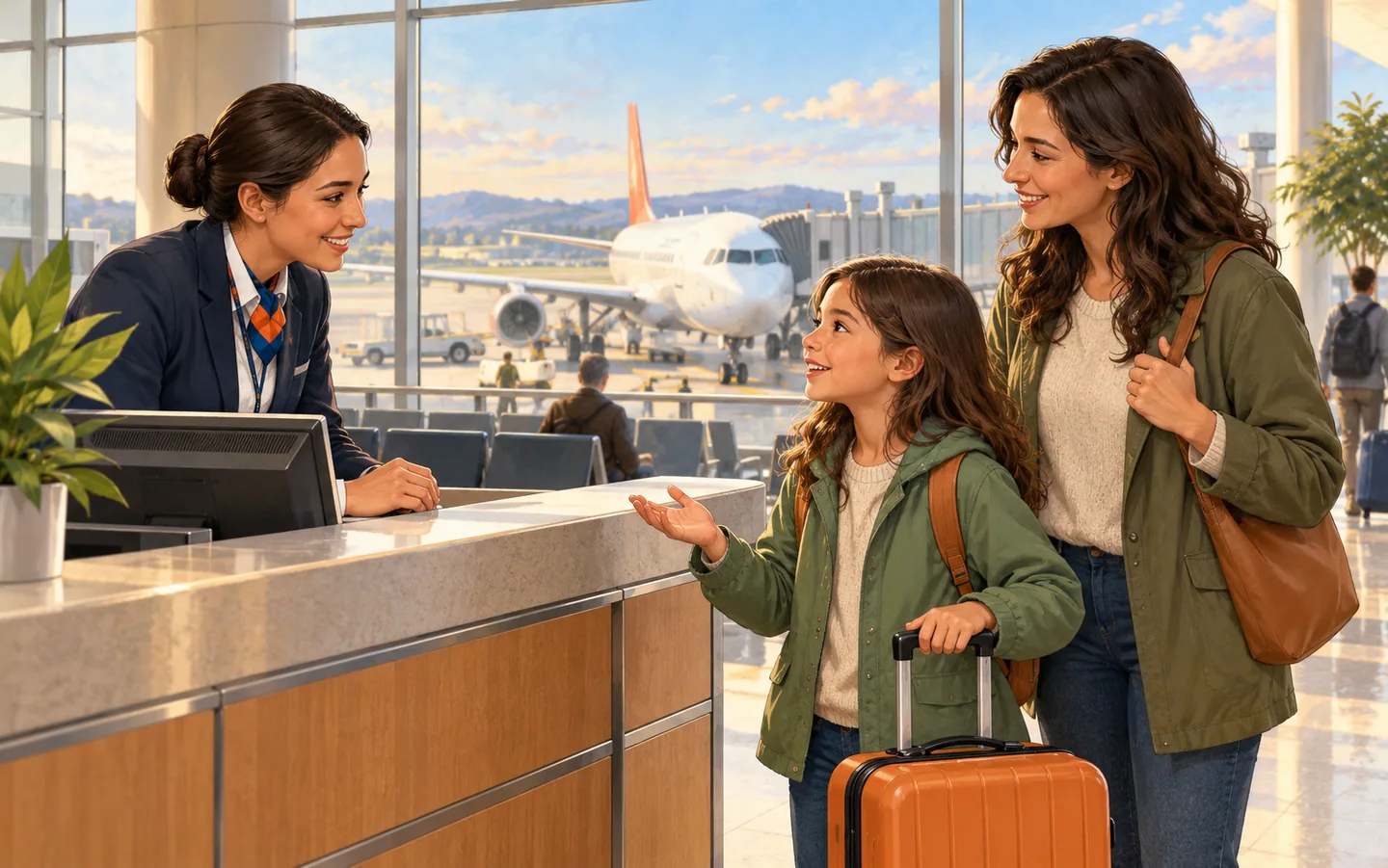
Quick answer: Start travel English with three purposes: asking where something is, requesting something and asking a speaker to repeat. Rehearse at home and offer your child an optional small part in real conversations. The adult remains responsible for travel arrangements and safety. These role plays are Stayeng's practical activity suggestions, not a readiness test for independent travel.
2026-10-27 · Stayeng parent guide
Key points
- Choose two or three useful phrases at a time.
- Practise understanding the answer as well as asking the question.
- Make asking for repetition part of every scene.
- Keep real conversations optional and adult-supported.
Put this guide into practice
- We chose one of the three travel scenes.
- We practised a question with two possible answers.
- We swapped passenger and staff roles.
- We told the teacher which situation we want to practise.
What would you say on this journey?
Choose a useful response, then ask someone playing the staff member to answer it.
You would like some water on the plane. Which is a polite request?
- Where is my room?
- Could I have some water, please?
- I am a suitcase.
Answer and explanation
Could I have some water, please?: “Could I have…?” works for a request. The other person might reply “Of course.” You can finish with “Thank you.”
You did not understand the employee's answer. What could you say?
- Could you say that again, please?
- My bag is orange.
- See you next week.
Answer and explanation
Could you say that again, please?: Asking for repetition keeps a conversation going. “More slowly, please” can also help.
The hotel employee says the breakfast room is “on the first floor”. What does that tell you?
- The colour of your room
- The weight of your suitcase
- The floor where the breakfast room is
Answer and explanation
The floor where the breakfast room is: It describes a location. Floor-numbering conventions differ between countries; in a real hotel, check signs or ask the employee to show you.
Aim for one useful exchange, not managing the trip
A child may recognise airport and ticket but still find the answer to “Where is gate six?” difficult. Build practice around a question, a possible answer and a short response. That gives the language a purpose beyond remembering a list.
The British Council's home-speaking guidance recommends supporting meaning with gestures and leaving time for a reply. In a travel rehearsal, show a location first, then try again with less help. A sentence that feels comfortable at home may still feel difficult in a busy terminal.
1. At the airport: find your gate
Put paper signs numbered 6 and 8 on two chairs. Give your child an imaginary boarding card with a plane drawing. There is no need for real tickets, identity documents or personal information. Play the passenger first so your child can see how the exchange works.
Passenger: “Excuse me. Where is gate six?” Employee: “It's over there.” Passenger: “This way?” Employee: “Yes.” Passenger: “Thank you.” Change the gate for the second round so the child has to listen rather than walk to a remembered place.
- Starting out: “Gate six, please?” with a pointing gesture.
- More comfortable: the full question and a checking question.
- Ready for a change: “Is this gate six?” answered with “No, this is gate eight.”
2. On the plane: make a request
Use a cup and a napkin as two simple props. Start with either “Could I have some water, please?” or “Could I have a napkin, please?” The adult playing the crew member replies “Here you are”, and the child says thank you.
In the second round, reply “One moment, please.” The request does not always produce an immediate result, which makes the exchange more realistic. Adults should directly communicate important information such as allergies, medication or urgent needs; those responsibilities should never depend on a child's newly learned phrases.
3. At the hotel: ask where something is
Draw a reception desk, breakfast room and lift on paper. Ask “Where is the breakfast room?” and answer “It's next to the lift.” Have your child point to the right place. Rearrange the drawing before the next attempt.
Add “What time is breakfast?” only if time expressions are already familiar. You might practise understanding “From seven to ten.” There is no need to finish every scene in one sitting. One understood exchange is a reasonable place to start.
Useful repair phrases: “Could you say that again, please?” · “More slowly, please.” · “Could you show me?”
Make the task smaller when the words will not come
Offer two pictures first, then model a word and a short request. You could move from “Water” to “Some water, please” to “Could I have some water, please?” Accept a meaningful short version rather than withholding the prop until the longest sentence is perfect.
Leave a few seconds for a reply. If your child gets stuck, supply only the missing part rather than answering everything. On another day, try the same structure with a different object. This helps you observe whether the child can use the phrase beyond one memorised script.
Bring one travel goal to a live lesson
Stayeng offers live one-to-one English lessons for children aged 4–15. Tell the teacher about an upcoming journey and one situation your child would like to practise. “Make a request and respond to the answer” is easier to observe than “memorise five travel sentences”.
After your home rehearsal, note three things: which question needed no prompt, whether the answer was understood, and whether the child asked for repetition. These observations are not a fluency score. They are concrete examples a teacher can use when planning suitable support.
Want to bring this practice into a one-to-one lesson?
Choose an activity from this guide to discuss with your teacher. For regular lessons, compare package lesson counts, lesson lengths and total prices. If you would like to meet a teacher first, choose a free trial.
Frequently asked questions
Does my child need a particular English level?
The simplest role plays can begin with pointing or single words. Add full questions and varied answers according to what your child can already understand. Age alone does not determine the right difficulty.
What if my child will not speak during the actual trip?
Handle the conversation yourself and offer a smaller optional role, such as saying thank you. A busy airport is not a speaking exam. You can return to the rehearsal later.
How many travel phrases should we learn?
There is no required number. Using a few phrases with different answers can be more practical than repeating a long list without understanding it. Start with one of this guide's three purposes.
Can we use these situations in Stayeng lessons?
You can share a travel goal with the teacher and request a suitable role play. Agree on the appropriate language and task with the teacher based on your child's needs.