Planning online English lessons for siblings
Plan English lessons for two children without assuming they need the same course. Compare individual goals, devices, available times and the family budget.
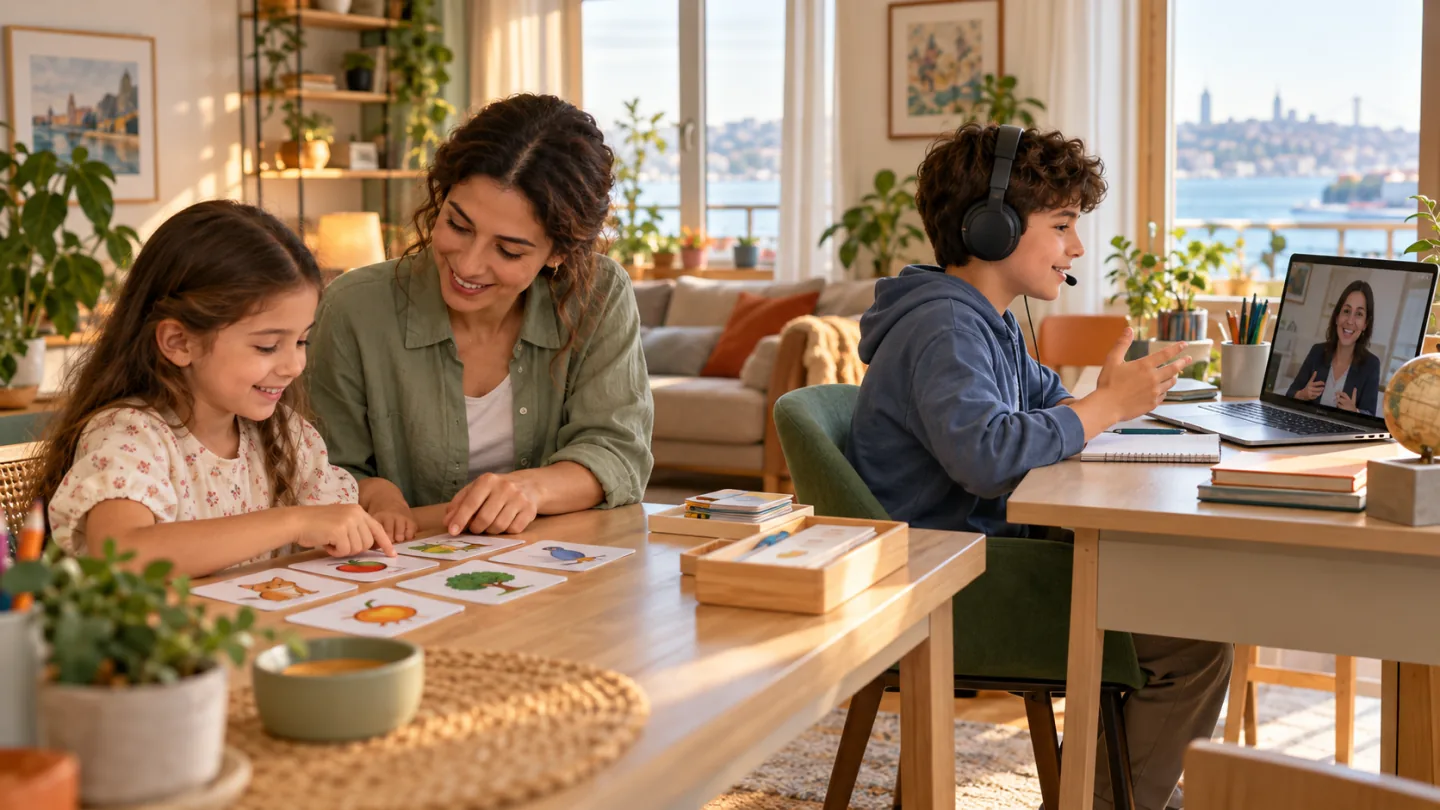
AI-generated image; illustrative scene.
Quick answer: Two children in the same family may need different English lesson plans. Start with each child’s current abilities and speaking goal, then plan devices, suitable times and the household budget together. Shared activities at home can be useful, but they do not replace the individual lesson time allocated to each child.
2026-11-01 · Stayeng parent guide
Key points
- Choose a separate speaking goal for each child.
- Plan lesson times, devices and quiet spaces together.
- Compare the whole-family package commitment, not only one lesson’s price.
Look beyond the age gap
One child might be learning to request an object while the other is working on explaining why something happened. Attending the same school or using the same book does not make their needs identical. Note what each child understands, what they can say and which help makes a task manageable.
The British Council’s guidance on how children learn recommends considering interests and suitable activities. A topic that motivates one sibling does not have to suit the other. Avoid building the whole learning plan around the older child’s level.
Be clear about whose lesson it is
In a one-to-one lesson, the teacher’s time and feedback are planned for one learner. Two siblings appearing on the same screen should not be treated as two separate students receiving regular lessons through one package. If a provider offers shared lessons, check whether that is a different service with different conditions.
Stayeng’s live lessons are one-to-one. Plan each child’s needs and package separately. If you prefer the same teacher for both children, check whether suitable times exist for each of them. Do not assume that consecutive appointments will always be available.
Check the practical details of a two-child timetable
First, count the devices you can actually use for lessons. With one computer, avoid booking two sessions at the same time. Then consider the teaching space: a sibling playing loudly, answering from behind the camera or trying to join in can interrupt the lesson.
Allow a short handover period for the device, connection check and the next child’s preparation. Consecutive lessons may work well. If they create a rushed changeover every week, different days may be a more workable choice. A convenient-looking timetable is only useful when the family can follow it.
Use one home activity with different language goals
Imagine setting up a toy shop together. A beginner could ask, “A red car, please.” A sibling who speaks more comfortably could try, “Do you have a smaller car?” The setting is shared, but the expected language is different. There is no need for both children to produce equally long answers.
Swap the shopkeeper role too. Do not make the older child a permanent translator or assistant teacher; they also need room to ask their own questions and make mistakes. Keep the activity cooperative rather than competitive. Record one thing each child managed with less help, separately.
Compare the whole family commitment
Look at each package’s total price and lesson count, and whether the selected payment dates fall in the same month. If a discount is shown, check which child and package it applies to in the payment summary. A monthly equivalent does not, by itself, mean you are purchasing a monthly subscription.
Use Stayeng’s pricing page for current options. Avoid choosing a longer or more frequent plan solely to make the two children’s programmes identical. A useful plan fits each learner’s goal and the times your family can realistically maintain.
Your two-child planning sheet
Complete the prompts separately. You can use Child A and Child B instead of names.
- The first speaking goal and a favourite topic…
- Two time windows this child can realistically attend…
- The device and quiet space they will use…
- I have checked the total package commitment and payment dates.
Prepare this note for yourself; it is not automatically sent to a teacher.
Want to bring this practice into a one-to-one lesson?
Find a suitable plan for each child and your family budget.
Frequently asked questions
Do siblings need to be at the same English level?
No. Their needs should be considered individually. At home, a shared topic can still have different language goals.
Do they have to use the same teacher?
No. Teacher fit and available lesson times can be considered separately for each child.
Can siblings share a one-to-one lesson?
Plan a one-to-one lesson for one learner. If you want a shared class, ask the provider whether that service is available before purchasing.