English Listening for Kids: Three Small Missions at Home
Give listening a purpose beyond playing another video: find an object, follow two steps or ask for the detail that is missing.
Quick answer: For English listening practice, start with familiar words and one clear task. Your child can show understanding by choosing an object, following a sequence or asking you to repeat. Add one new detail at a time. The activities below are practical home missions, not a test that assigns an English level.
2026-10-23 · Stayeng parent guide
Key points
- Tell your child what to listen for before you begin.
- Pointing or moving an object can show understanding without a spoken answer.
- Avoid making both the vocabulary and the instructions harder at once.
- Asking for repetition is a useful communication skill.
Put this guide into practice
- I chose three objects my child already knows in English.
- We tried one instruction, then a two-step sequence.
- I reduced one kind of help and noted what happened.
- I shared one successful instruction and one difficult example with the teacher.
Choose the useful listening task
Pick the response that helps the child understand in each situation. This is not a language-level score.
Your child does not know “basket” in “Put the bus in the basket.” What should you try first?
- Say the sentence louder
- Show the basket, introduce the word and try again
- Play a much longer recording
Answer and explanation
Show the basket, introduce the word and try again: Connect the unfamiliar word with the object first. One unknown word can stop the task; extra volume will not explain it.
Your child follows the instruction correctly but does not speak. What can you conclude?
- They may have understood this instruction
- They learned nothing
- They can now understand every English conversation
Answer and explanation
They may have understood this instruction: The action is evidence about this particular task. It does not establish a general language level or speaking ability.
A two-step instruction is confusing. How could you simplify it?
- Add a third step
- Stop practising completely
- Give each step separately, then put them together
Answer and explanation
Give each step separately, then put them together: Try “Pick up the cup.” and then “Put it on the table.” Once each works, combine them.
Why give listening a small purpose?
“Listen to this” can be a vague instruction. “Find the toy I mean” gives your child a reason to pay attention. It also lets you observe understanding instead of assuming that sitting quietly means following the message.
The British Council’s home-English guidance recommends using gestures to support meaning and allowing time for a response. The three missions here are Stayeng activity suggestions built around those broad principles.
Prepare in two minutes
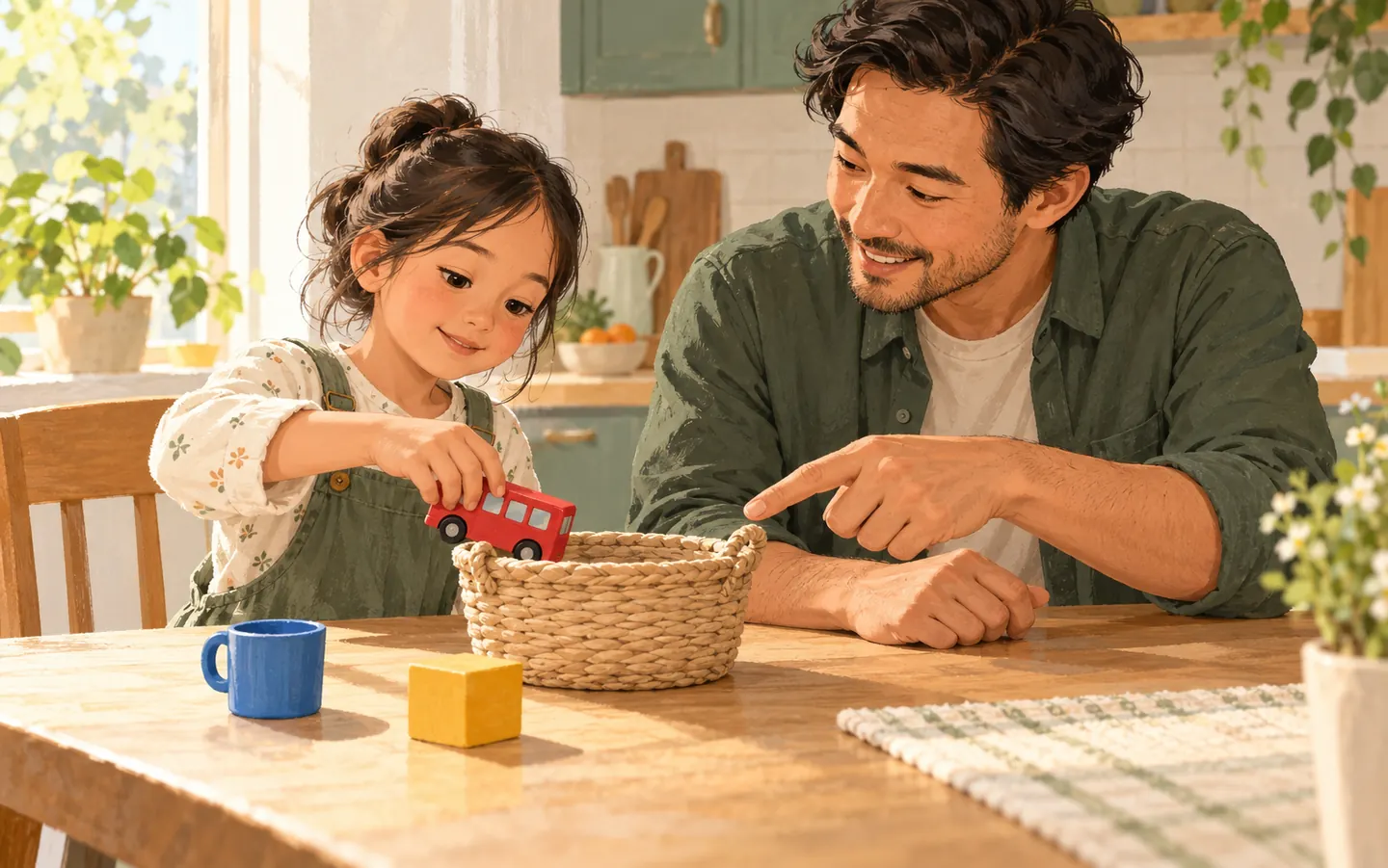
Put three familiar objects on a table: a toy bus, a cup and a book, for example. Check their English names together first. Turn off background sound and make sure all the objects are easy to see.
Demonstrate the first turn. On the next turn, reduce your gesture so your child has a chance to follow the words. Wait a few seconds rather than immediately repeating or translating. If the task stalls, show one word or action again.
Ask “Could my child find the object from this instruction?” rather than “Did my child understand every word?”
Mission 1: Find the toy’s new home
Start with “Show me the bus.” Then try “Put the bus in the basket.” One turn is complete when the correct object reaches the correct place. Repeat with another familiar object.
If this is easy, introduce two similar objects, such as a red bus and a blue bus, so colour matters. If it is difficult, use one object and practise only the location. Keep the objects visible at first: hiding them would turn the activity into a different guessing game.
- Start: “Show me the cup.”
- Add a detail: “Show me the blue cup.”
- Move it: “Put the blue cup next to the book.”
Mission 2: A tiny packing list
Pretend you are packing for a picnic. Say “Take the cup. Then take the book.” Ask your child to select the two objects in order. Use the same example to demonstrate that “then” introduces the second action.
If the order gets mixed up, do not immediately label this an English problem. Remembering the sequence or handling the length of the instruction may also be difficult. Separate the steps and try again. Record whether your child managed each step alone, the combined sequence, or needed a gesture.
Mission 3: Ask for the missing detail
For a more confident learner, put two cups on the table and say only “Take the cup.” You have not said which cup. Model “Which one?” or “The blue one?” so the child can clarify your message.
There is no hidden correct answer in this version. The point is to notice missing information, not win a guessing contest. Practise “Can you say that again?” too. It is a phrase your child can use for a real purpose in their next lesson.
Adapt the mission and notice the support needed
For ages 4–6, use toys and movements; a few good turns may be enough. For ages 7–9, try ordering picture cards. For ages 10–15, choose a game plan, a sports bag or directions to a place. These are starting suggestions, not strict age rules.
Try the task on another day with one small change. Note the help needed rather than just the number of repetitions. Tell your Stayeng teacher “Two objects are fine, but the order gets mixed up” instead of “Listening is bad.” In a one-to-one lesson, the teacher can explore that observation with an appropriate activity.
Want to bring this practice into a one-to-one lesson?
Choose an activity from this guide to discuss with your teacher. For regular lessons, compare package lesson counts, lesson lengths and total prices. If you would like to meet a teacher first, choose a free trial.
Frequently asked questions
Should I translate every English instruction?
Try an object, picture or action before automatically translating each sentence. A new concept may need a brief explanation in your shared language, followed by the English example.
Can my child practise listening without speaking?
Yes. Choosing an object or ordering cards can show understanding of that task. You can add a short spoken response later without making speaking compulsory on every turn.
Do we need videos or a paid app?
No. Three household objects and an adult are enough. If you use audio, choose a short, suitable passage and give the child a clear detail to listen for.
How quickly should listening improve?
There is no guaranteed timetable. After a few short turns, notice interest and how much help is needed. Simplify a difficult task instead of making the session longer.