Can and Can’t for Children: What Can I Do?
Practise can and can’t with imaginary character cards, short conversations and interactive questions, without comparing children’s abilities.
Quick answer: Can and can’t can describe ability. Start with a familiar action, such as “I can draw,” then add “Can you draw?” Imaginary characters let children practise positive and negative answers without turning their real abilities into a competition.
2026-10-07 · Stayeng parent guide
Key points
- Use the base verb after can.
- Personal answers depend on the child’s experience.
- Imaginary characters create room to experiment.
Put this guide into practice
- Choose three familiar actions: draw, sing and dance.
- Give an imaginary character two abilities.
- Ask a question, listen and swap roles.
Solve the character card
Momo can draw and sing but cannot dance. Answer using this imaginary character’s card.
Momo is able to draw. Which sentence works?
- Momo can to draw.
- Momo can draw.
- Momo can draws.
Answer and explanation
Momo can draw.: Use draw after can, without to or an -s ending.
Can Momo dance?
- No, Momo can’t.
- Yes, Momo can.
- Momo is a pencil.
Answer and explanation
No, Momo can’t.: The card says Momo cannot dance, so choose the negative answer.
How do you ask about Momo’s singing?
- Momo a song?
- Does can Momo sing?
- Can Momo sing?
Answer and explanation
Can Momo sing?: Put can before the character’s name to make this question.
Build one useful pattern
Try “I can draw” and its negative, “I can’t draw.” Do not add to or -s to the following verb: “She can draw.” Ask “Can you draw?” and offer the short replies “Yes, I can” or “No, I can’t.” Keep the explanation brief.
For the first round, show a character picture instead of giving a grammar lecture. If the character is singing, model “She can sing.” Your child can select the picture even before producing the whole sentence. Use written practice after the meaning is clear.
Design a curious character
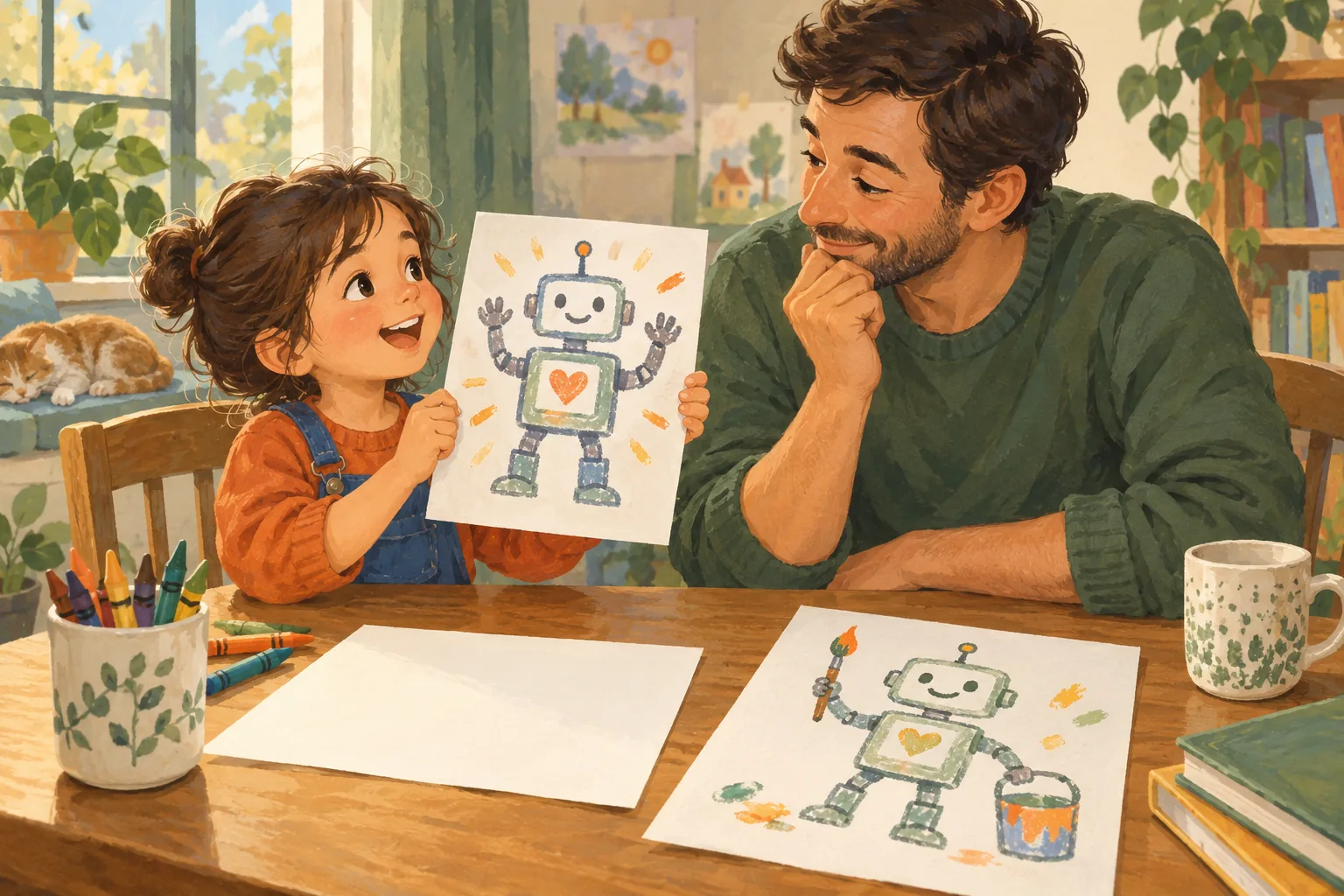
Draw an imaginary robot on paper. Give it the ability to draw, but say it cannot dance. Show those features with two small pictures. Ask “Can the robot dance?” Your child checks the card and answers “No, it can’t.” Then let them design a different robot and question you.
The character does not need to be good at everything. When it cannot do something, introduce a friend who says “I can help.” In this story, can’t opens a conversation about assistance instead of labelling a failure. There is no need to compare siblings or real friends.
Accept a child’s own answer
Not every child will answer “Can you sing?” in the same way. While practising the English pattern, avoid arguing with their view of their own ability. If they say “No,” you can model “No, I can’t,” then choose another action.
Do not require a child to demonstrate a physical skill to prove their answer. They can choose a drawing while seated, speak for a fictional character, or ask you a question. Options without physical movement can work towards the same language goal. This is not a developmental assessment.
Make the next exchange purposeful
Once your child distinguishes positive and negative statements, add a shared task: “Can you draw a dragon?” — “Yes, I can.” — “Can you help me?” — “Yes!” Complete the picture together. English now helps accomplish something rather than simply name an action.
You can ask the Stayeng teacher to try a similar character activity in a one-to-one lesson. At home, note one sentence and whether your child said it independently or selected it from choices. Use a different character next time. Answering three questions correctly is not a measure of overall English proficiency.
Want to bring this practice into a one-to-one lesson?
Choose an activity from this guide to discuss with your teacher. For regular lessons, compare package lesson counts, lesson lengths and total prices. If you would like to meet a teacher first, choose a free trial.
Frequently asked questions
At what age should children learn can and can’t?
There is no single required age. Start when familiar actions make sense to the child; an adult can read questions that require literacy.
Is “He can draws” correct?
No. Use “He can draw.” Model the correct form briefly and return to the conversation.